The Biology Education Program at the Faculty of Teacher Training and Education, Islamic University of Riau (Biology Education Program FKIP UIR) in Pekanbaru was established based on the Minister of Education and Culture of the Republic of Indonesia Decree No.085/0/1984 dated March 5, 1984. Academic activities commenced in the Academic Year 1985/1986. The Biology Education Program FKIP UIR is one of the 9 programs offered by FKIP UIR. At its inception, the Biology Education Program had 3 faculty members. Currently, the Biology Education Program consists of 12 permanent faculty members with qualifications ranging from Master’s to Doctorate degrees. The Biology Education Program at the Faculty of Teacher Training and Education, Islamic University of Riau, has been accredited with a very good rating according to the BAN-PT Decree No. 994/SK/BAN-PT/Akred/S/II/2021.”
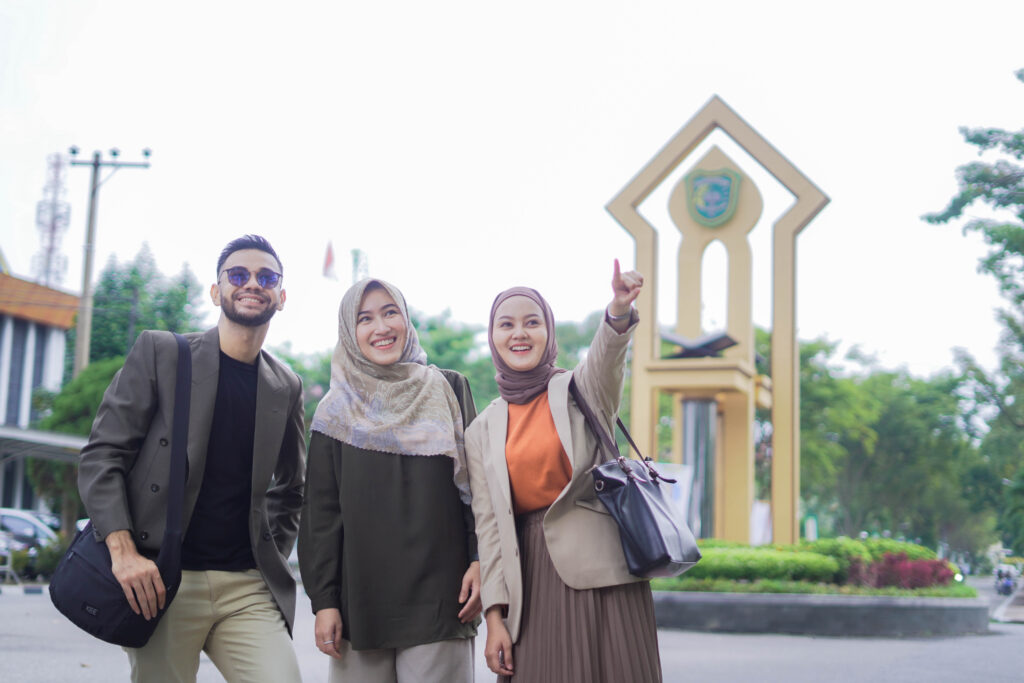
VISION
“To advance the excellence, competitiveness, and professionalism of the field of Biology Education through educational activities, research, community service, and Islamic propagation based on cultural and local potential. “
MISSION
To conduct academic and Islamic propagation activities by optimizing local culture and potential, aiming to develop knowledge and technology that produce outstanding, competitive, devout, and morally upright graduates in the field of Biology Education
MBKM CURRICULUM FOR BIOLOGY EDUCATION
The National Qualifications Framework (KKNI) with Merderka Belajar-Kampus Merdeka (MBKM) Higher Education Curriculum is an institutional mandate that must be constantly updated in line with the evolving needs and science and technology advancements outlined in Learning Outcomes. The curriculum of study programs in higher education institutions, as contributors to educated graduates, needs to assess whether the graduates possess skills equivalent to the learning outcomes formulated within the National Qualifications Framework (KKNI). To enhance the alignment between higher education graduates and the rapidly changing world of business and industry, the Ministry of Education and Culture implemented a new policy in early 2020 called the “Merdeka Belajar – Kampus Merdeka (MBKM)” program.
The Merdeka Belajar-Kampus Merdeka (MBKM) policy is supported by diverse forms of learning (Article 14 SN-Dikti) and provides facilities for students to pursue their studies for three (3) semesters outside their study program (Article 18 SN-Dikti). The implementation of the Merdeka Belajar-Kampus Merdeka program is intended for Bachelor’s and Applied Bachelor’s programs. This program is still aimed at fulfilling the Learning Outcomes of Graduates specified by each study program but with different forms of learning. Students have the right to undertake learning activities outside their program for 3 semesters, providing an opportunity to acquire additional competencies beyond the Learning Outcomes set by the study program, preparing them for entry into the workforce after graduation. Additionally, the experiences gained will strengthen graduates’ readiness to adapt to the evolving work environment, societal life, and cultivate a lifelong learning habit.
Scientific Goals of the Biology Education Study Program
Referring to the Vision and Mission, the scientific goals of the Biology Education Study Program are as follows:
Graduates of the Biology Education Program at FKIP UIR are Bachelor of Biology Education degree holders who embody the spirit of education with a focus on aspiration and care, guided by the principles of asah-asih-asuh (nurture, love, and guide). They possess the capability to apply their knowledge of biology and biology education in managing digital-age biology learning, effectively operate school laboratories, and creatively and innovatively solve problems in biology education through research and practical actions, producing nationally recognized work. They also demonstrate entrepreneurship skills and a commitment to lifelong learning. The graduate profile for the Biology Education Program at FKIP UIR is detailed in Table 1 below.
Tabel 1. Graduate Profile
Biology Education Program, FKIP UIR
No | Graduate Profile | Description |
1 | Biology Educator | An outstanding, competitive, and pious biology educator with high moral integrity, adhering to National Education Standards. They are capable of designing instruction that aligns with advancements in science, technology, social, and cultural contexts (Ipteksosbud). |
2 | Education and Biology Researcher | An expert researcher with advanced competencies in the fields of education and biological sciences, demonstrating excellence, competitiveness, piety, and high moral standards. |
3 | Bioedupreneur | An exceptional, competitive, and pious entrepreneur who excels in integrating the spirit of independence and entrepreneurship within the fields of education and biology. |
| Name | Unit |
|---|---|
| Rusli Nidos | Head of Administrative Affairs |
| Nasrul, S.PSi | Head of Academic Subdivision |
| Hj. Lestari, S.M | Head of Human Resources Subdivision |
| Sukrianto, S. Kom | Head of General Affairs and Agenda Subdivision |
| Fadli Ridwan, S. AB | Academic and Student Affairs Staff |
| Ardofi Saputra | Expedition and Staff Agenda |
| Muhammad Amin, S. T | Academic and Student Affairs Staff |
| Putri Dewi Pratiwi, S. Pd | General Affairs Staff |
| Richi Karuniawan | General Affairs Staff |
| Wenny Suzalfina, S. Sos | General Affairs Staff |
| Wulan Sari, S. Pd | General and Human Resources Staff |
| Deni Ardiansyah., S.Pd., M. Pd | Language Laboratory |
| Nurhayati, S. Pd | Performing Arts Laboratory |
| Romi Putra, S.Pd | Physical Education Laboratory |
| Habibullah, S. Pd | Physical Education Laboratory |
| Muslim | General Affairs Staff |
| Ruslan Suman | General Affairs Staff |

Kampus Universitas Islam Riau
Jl. Kaharuddin Nasution 113, Pekanbaru 28284
Indonesia
Telepon : +62 821-7332-1100
Email : [email protected]